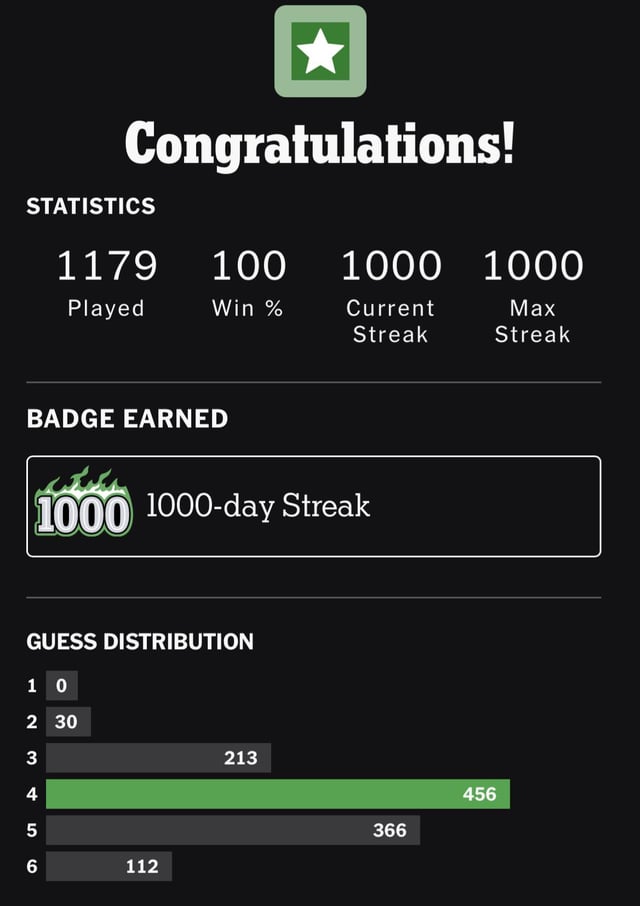
Guaranteed Wordle Wins: How Optimal Play Keeps Your Streak Alive
For many, the daily Wordle is more than just a quick word game; it's a ritual, a mental warm-up, and a test of linguistic prowess. The ultimate goal? Keeping that coveted streak alive, day after day. Whether you're tackling a brand new challenge like Wordle puzzle #1722 (whenever it may arrive) or any other, the dream is a guaranteed win. The good news is, achieving a near 100% win rate is not just a pipe dream. With optimal play, mastering Wordle isn't about luck; it's about strategy, information, and a deep understanding of the game's mechanics.
The core insight, often surprising to casual players, is that if you play optimally, virtually every starting word can lead to a guaranteed win. Yes, even words typically considered "bad" starters, like QAJAQ, can lead to victory if followed by the most informed subsequent guesses. This principle holds true even for the more challenging "Hard Mode." This revelation shifts the focus from finding the single "best" starting word to understanding the underlying principles that drive successful Wordle play.
Understanding Wordle's Anatomy: Guessable vs. Answer Lists
Before diving into strategy, it’s crucial to understand a fundamental aspect of the official NYT Wordle game: it operates with two distinct word lists. There's a much larger list of approximately 12,974 "guessable" words – any five-letter English word that the game will accept. However, the list of words that can actually be the *answer* on any given day is significantly smaller, comprising around 2,309 words. This distinction is vital because optimal play focuses on rapidly narrowing down the possibilities within that smaller answer list, rather than just guessing random words from the larger dictionary.
Optimal play is less about finding letters and more about eliminating possibilities. Every guess, regardless of whether it yields green, yellow, or gray tiles, provides valuable information. A gray letter tells you it's not in the word at all. A yellow letter tells you it's in the word but in a different position. A green letter confirms its presence and exact position. All of these pieces of information contribute to systematically reducing the pool of potential answer words. This iterative process of deduction is what ultimately secures your win, ensuring your streak remains unbroken.
Maximizing Information: The Power of Initial Guesses
While optimal play can salvage a game even with a suboptimal first word, choosing a strong opener significantly accelerates the process. Many metrics have been proposed to rank starting words, but not all are created equal.
The "Average Greens" Metric: Simple but Limited
A straightforward approach is to evaluate how many green tiles a word gets on average. By this metric, words that contain common letters in common positions tend to score highly. Based on analysis of the official NYT wordlist, some top performers in terms of average greens include:
- saree: 0.680814 greens
- sooey: 0.679515 greens
- soree: 0.669987 greens
- saine: 0.666522 greens
- soare: 0.65916 greens
When considering only the answer list, other strong contenders emerge:
- slate: 0.620182 greens
- sauce: 0.608922 greens
- slice: 0.607622 greens
- shale: 0.60589 greens
- saute: 0.604158 greens
These words are decent choices, primarily because they incorporate high-frequency letters like 'S', 'A', 'E', 'R', 'L', and 'T'. However, focusing solely on greens can be misleading. A green 'E' might not provide as much discriminative power as a yellow 'X' or 'Z' if those rarer letters are the only difference between two possible answers. All information counts, and some information is more valuable than others.
Information Theory: The Gold Standard for Optimal Play
A more sophisticated and generally accepted method for ranking starting words involves Information Theory. This approach, popularized by figures like 3blue1brown, measures how much a guess narrows down the possible answers, converting this into "bits" of information. The goal is to choose words that, on average, reduce the answer space most efficiently, regardless of whether the tiles turn green, yellow, or gray. Words that maximize information tend to test a diverse set of common letters in various positions, allowing for maximum elimination power with a single guess.
By information theory, the best starting words are:
- soare: 5.8852 bits
- roate: 5.88486 bits
- raise: 5.8783 bits
- reast: 5.86774 bits
- raile: 5.86515 bits
Focusing specifically on the answer list, the top words for information theory are:
- raise: 5.8783 bits
- slate: 5.85582 bits
- crate: 5.83522 bits
- irate: 5.8328 bits
- trace: 5.83043 bits
These words are often lauded because they strategically place high-frequency vowels (A, E, O, I) and common consonants (R, S, T, L) to test a broad range of letter combinations and positions. For a more detailed look at these metrics, you can explore articles like Greens vs. Information Theory: Ranking Wordle's Top Starter Words and Wordle's Best Starting Words: A Deep Dive into Stats & Theory.
Beyond the First Word: Sustaining Your Streak with Strategic Guesses
While a strong opener is an excellent start, true Wordle mastery comes from how you follow up. Each subsequent guess should be a calculated move to extract maximum information.
The Art of Strategic Elimination
After your first guess, you'll have a set of greens, yellows, and grays. Your next step is to formulate a word that systematically addresses the remaining possibilities. If your first word didn't reveal many letters, consider a "burner" word – a second guess designed to introduce a completely new set of common letters (e.g., using words with 'D', 'U', 'N', 'C', 'H' if your first word used 'S', 'O', 'A', 'R', 'E'). This quickly expands your information base.
- Vowel and Consonant Coverage: Ensure your early guesses cover the most common vowels (A, E, I, O, U) and high-frequency consonants (S, T, R, L, N). Words like 'ADIEU' for vowels, or 'STERN' for consonants, are popular for this reason.
- Positional Logic: Use greens to lock in positions. Use yellows to confirm a letter's presence but rule out its current position. Grays eliminate letters entirely from your mental (or actual) word list.
- Targeted Elimination: As the game progresses, especially on the third or fourth guess, your focus should shift from general information gathering to targeted elimination. If you have only a few possible words left (e.g., BRACE, CRANE, GRAPE), pick a word that will differentiate between them by testing unique letters in the remaining ambiguous positions.
Navigating Hard Mode
Hard Mode presents an extra layer of challenge: any subsequent guess *must* use all previously revealed green letters in their correct positions and all yellow letters somewhere in the word. This restriction can feel daunting, but optimal play still prevails. The key is to think even more critically about each guess, ensuring it not only adheres to the rules but also maximizes information. For patterns like "_IGHT" where many words fit (LIGHT, NIGHT, MIGHT, RIGHT, SIGHT), hard mode forces you to choose a word that strategically tests the leading consonant while still using the 'IGHT' sequence, or to choose a word that tests one of the common leading consonants in another position early on to eliminate possibilities before you get to the '_IGHT' pattern.
Even in Hard Mode, the principle remains: choose the word that provides the most distinguishing information among the remaining possible answers, not just one that looks likely. With practice, you'll develop an intuitive sense for these optimal choices, helping you secure those tricky wins and preserve your streak.
Conclusion: The Path to Unbroken Streaks
Achieving a consistent Wordle winning streak isn't about magical starting words or sheer luck; it's about embracing a strategic, information-driven approach. By understanding the distinction between guessable and answer lists, leveraging information theory to choose powerful initial words like 'RAISE' or 'SOARE', and making every subsequent guess a calculated move to eliminate possibilities, you equip yourself with the tools for near-guaranteed success. Whether it’s Wordle puzzle #1722 or any other daily challenge, optimal play transforms the game from a guessing game into a satisfying exercise in deductive reasoning, keeping your streak alive and well.